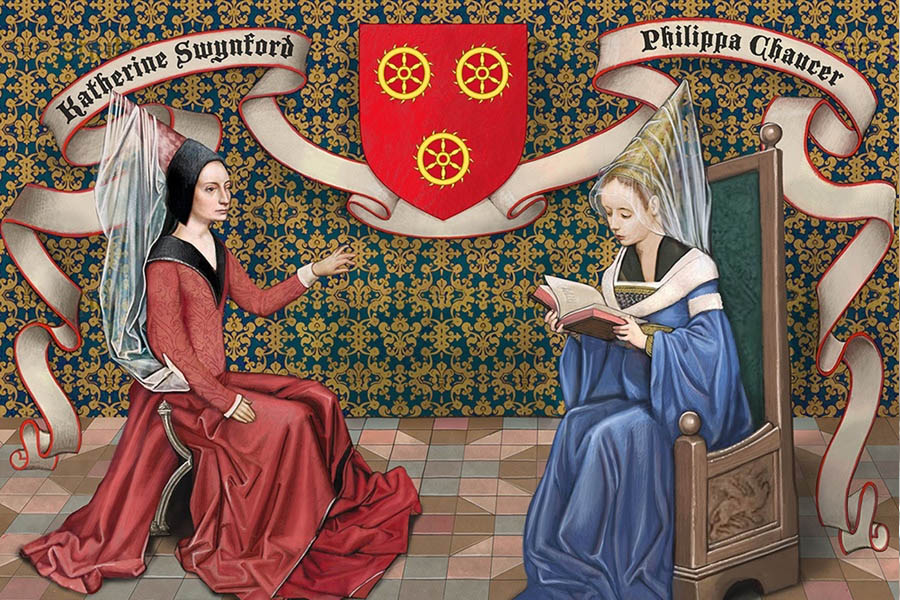
Philippa Roet in the Shadow and Light of a Medieval Court
Philippa Roet was a woman whose life moved like a candle flame in a drafty hall, steady and bright enough to leave a mark. She was presumably born around 1346–1348 and died in 1387. Her name appears as Philippa de Roet, Roelt, and Chaucer, but her personality stands out. She was a court lady, wife, mother, sister, and silent link between strong families.
The English royal court—rank, duty, presents, and delicate loyalties—was her universe. Philippa was born in Hainaut and joined the military young. As her father served Queen Philippa of Hainault, the Roet children undoubtedly had early court experience. That access counted. A medieval English room could be worth more than a chest of silver. Philippa entered wealthy houses and court society, where skill, trust, and proximity shaped lives.
The Roet Family and the Bonds That Mattered Most
I think the family story is the heart of Philippa Roet’s biography. Her relatives linked several major figures in English history, and those links formed a web stronger than silk and more durable than stone.
| Family member | Relationship to Philippa Roet | Notes |
|---|---|---|
| Paon de Roet | Father | A Hainaut knight or herald, attached to Queen Philippa’s circle |
| Katherine Swynford | Sister | One of the most famous women of her generation |
| Geoffrey Chaucer | Husband | Poet and royal servant |
| Thomas Chaucer | Son | Courtier, politician, and Speaker of the House of Commons |
| Elizabeth Chaucer | Probable daughter | Often identified as a nun at Barking Abbey |
| Lewis Chaucer | Probable son | Associated with Chaucer’s educational writing |
| Agnes Chaucer | Probable daughter | Appears in later family traditions and records |
| Alice Chaucer | Granddaughter | Daughter of Thomas Chaucer, later Duchess of Suffolk |
Paon de Roet stands at the start of the family line. He was a man of service and rank, and his position helped shape the opportunities available to his daughters. Philippa’s sister Katherine Swynford became even more famous than Philippa in the later story of the family. Katherine first married Hugh Swynford and later became the long-time companion and then wife of John of Gaunt. That made the Roet family part of the larger Lancastrian world.
Geoffrey Chaucer, Philippa’s husband, is the towering name most people recognize. Yet Philippa was not merely attached to his fame like ivy on a wall. Their marriage mattered in practical and political terms. It linked Chaucer more closely to court circles and may have supported his rise through patronage and service. Their son Thomas Chaucer became one of the major lay figures of the fifteenth century. He did not live in the shadow of obscurity. He was wealthy, influential, and active in government. Through him, Philippa’s line reached Alice Chaucer, who became Duchess of Suffolk and carried the family into another generation of high aristocratic power.
I also note the probable children with care. Elizabeth, Lewis, and Agnes appear in the broader family tradition, though the evidence is less firm than it is for Thomas. Medieval family records can be misty, like a road seen through rain, and I do not force certainty where the record is thin.
Philippa’s Court Career and Her Place in the Household World
Philippa Roet’s career was court service. That phrase sounds plain, but in medieval England it meant access, discipline, trust, and a place near the pulse of power. She served in royal and noble households, including those connected to Queen Philippa and later Constance of Castile. She seems to have been one of those women whose skill lay not in public speeches or military deeds, but in consistency. Court life depended on people who could keep order, remember details, manage presence, and understand rank without needing to announce it.
One nickname attached to her is “Philippa Pan,” which suggests a household role and perhaps a specific function in service. That kind of detail is small, but I find it revealing. Medieval households were not abstract institutions. They were living structures, full of offices, errands, and human relationships. Philippa seems to have been part of that living structure for years.
Her financial record is unusually visible for a woman of her time. She received pensions and annuities, including payments in the 1370s and 1380s. These were not just tokens. They were signs of ongoing favor and recognition. I read them as proof that she was valued. In a century where a stable income could mean security for a household and dignity for a family, these grants were a kind of lifeline.
The Marriage to Geoffrey Chaucer and the Shape of a Household
Geoffrey Chaucer married Philippa in 1366. Medieval households are individualistic and strategic. Romance is not limited to modern times. A household founded on service, ambition, and patronage comes to mind. In a time where marriage might increase influence, Philippa’s court contacts were crucial to Chaucer’s career.
Their collaboration created a legendary English family. Thomas Chaucer was the marriage’s strongest child, and Alice Chaucer continued the dynasty. Elizabeth, Lewis, and Agnes, the likely children, provide character to the household. They remind me that Philippa’s life went beyond status. It involved raising children, keeping a household, and surviving medieval weather.
Philippa can be overlooked due to Geoffrey Chaucer’s prominence. That frame is too small. She helped make his life feasible and received royal attention for her service. 14th-century households were like ships under canvas. Despite only one name being immortalized, everyone was important to the expedition.
Family Legacy and Why Philippa Roet Still Matters
Philippa Roet matters because she stands at the center of a remarkable network. Her sister Katherine Swynford became a duchess. Her husband Geoffrey Chaucer became the great poet of English literature. Her son Thomas Chaucer became a major political figure. Her granddaughter Alice Chaucer became a duchess in her own right. That is not a minor family line. It is a constellation.
I am struck by how often her story is told through other people. That happens to many women in medieval history. Yet if I strip away the famous names, Philippa still remains. She was a court woman with her own record of service, her own income, her own marriage, her own children, and her own position in a courtly world that rewarded reliability as much as brilliance. She was not a thunderclap. She was more like a river beneath the floorboards, shaping what stood above it.
FAQ
Who was Philippa Roet?
Philippa Roet was a fourteenth century English court lady, the wife of Geoffrey Chaucer, and the sister of Katherine Swynford. She belonged to a family that became closely connected to royal and noble power.
What was Philippa Roet known for?
I would say she was known for court service, her marriage to Geoffrey Chaucer, and her place in a family that produced major historical figures. She also received pensions and annuities that show she was respected in court circles.
Who were Philippa Roet’s closest family members?
Her father was Paon de Roet, her sister was Katherine Swynford, her husband was Geoffrey Chaucer, and her son Thomas Chaucer was the most prominent of her children. Her granddaughter Alice Chaucer later became Duchess of Suffolk.
Was Philippa Roet wealthy?
She does not appear wealthy in the grand aristocratic sense, but she had a meaningful stream of patronage. Her pensions and court payments suggest financial security and regular recognition.
Did Philippa Roet have children?
Yes, Thomas Chaucer is the best documented child. Elizabeth Chaucer, Lewis Chaucer, and Agnes Chaucer are commonly treated as probable children, though the evidence for them is less secure.
Why is Philippa Roet important in history?
She matters because she connects several major medieval figures through family, service, and patronage. Her life helps explain how court networks worked and how one household could influence politics, literature, and noble lineage for generations.